
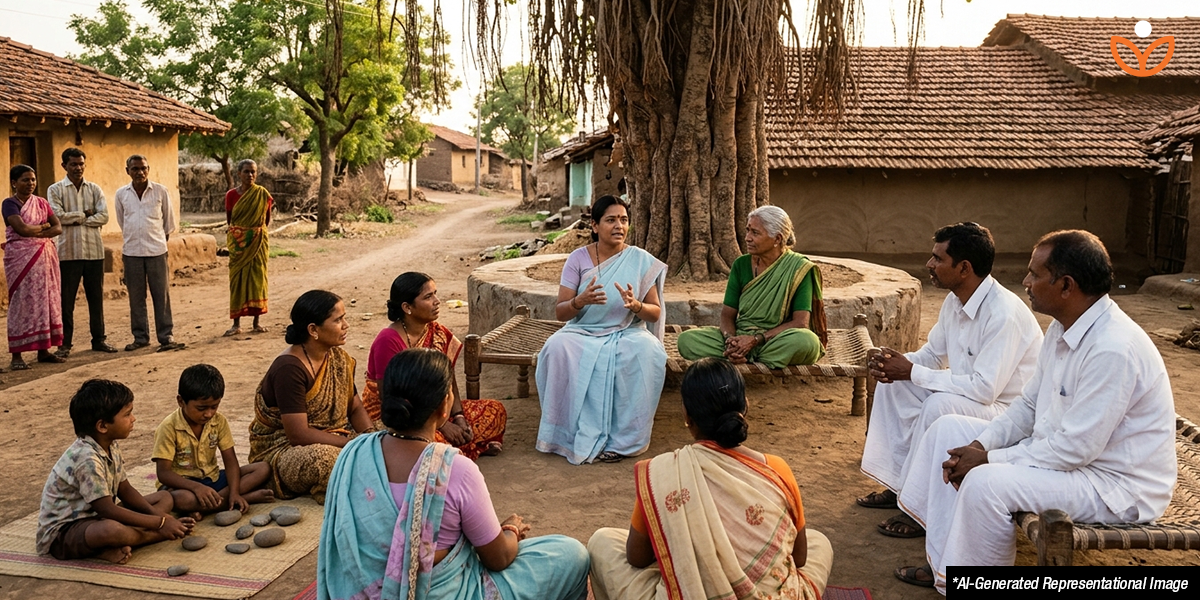
In the forested, predominantly tribal regions of eastern Maharashtra, child protection is closely tied to the everyday realities of families.
In Chandrapur and Gadchiroli, families depend largely on rain-fed agriculture, daily wage labour, forest-based occupations and small businesses. Seasonal migration is widespread, often disrupting children’s schooling, care and access to support. These challenges reflect wider vulnerabilities across Maharashtra, but in remote tribal communities, poverty, migration, distance from services and limited access to higher education often intersect, increasing children’s exposure to risks such as dropout, child labour, neglect, child marriage and family separation.
The response, therefore, cannot begin only after a child reaches crisis. It must begin within families and communities — by identifying vulnerability early, strengthening families and enabling local institutions to act.
It was in this context that Miracle Foundation India, in partnership with Amhi Amchya Arogyasathi (AAAS), launched the Family Strengthening and Family-Based Alternative Care (F-BAC) program across 19 Gram Panchayats covering 43 villages in Chandrapur and Gadchiroli. The approach was simple: children are safer when families are stronger and communities are equipped to protect them. The program therefore focused on strengthening existing village systems, particularly the Village-Level Child Protection Committees (VLCPCs).
Why Start with the Community?
The baseline revealed a concentrated pattern of vulnerability. The program area covered nearly 28,553 people across 6,694 households, with migration reported in every intervention village and 82% of reported migration being seasonal. Nearly 74% of households belonged to priority categories such as Below Poverty Line (BPL), Antyodaya or other vulnerable classifications.
The assessment identified 385 vulnerable families with 748 children. Extreme poverty and single-parent households were the leading vulnerability factors, each accounting for 31% of cases, while violence, addiction, neglect, child labour, child marriage and domestic violence together contributed another 20%.
Education added another layer. While primary and upper-primary schools were available in most villages, access to senior secondary education was more difficult, often requiring adolescents to travel or relocate. This mirrors a wider Maharashtra challenge, where secondary-level dropout has historically been significantly higher than at the primary level.
What emerged was not vulnerability caused by one factor, but by multiple risks reinforcing one another. A family facing economic hardship may also be migrating; an adolescent may face both disrupted schooling and limited access to services.
This made the case for a preventive, community-based approach clear. If vulnerability exists within families and communities, communities must also have the capacity to recognize it, respond early and mobilize support. The VLCPC was therefore positioned not simply as a committee, but as a local mechanism for turning community awareness into timely action for children and families.
The Starting Point: Structures That Existed but Didn’t Function
The first question the program asked was not “What new institution should we create?” It was: “How can we strengthen the institution that already exists?”
Across the intervention villages, 46 VLCPCs comprising 304 community members had already been constituted — but none were functioning effectively when the program began. Members were often unclear about their responsibilities; meetings were irregular; and early opportunities to identify vulnerable children and families were being missed.
The task, then, was not simply to get meetings happening. It was to shift how community members understood the VLCPC’s purpose in the first place — to help them see child protection not as the sole domain of government departments or specialized institutions, but as a shared community responsibility.
From Activation to Ownership
Activation began with sustained engagement, mentoring and handholding. Committee members were supported to understand their roles and to recognize the kinds of vulnerability that put children at risk.
Gradually, the focus shifted from “Did a meeting happen?” to a sharper set of questions:
- Which children or families may be vulnerable?
- What risks are they facing?
- What support is available within the community?
- Which government service or institution can help?
- What can the VLCPC do itself?
- What needs to be followed up?
This shift turned the VLCPC from a statutory structure on paper into a platform for collective problem-solving. Meetings began bringing together village leaders, frontline workers, teachers, Anganwadi workers, ASHAs, parents and other community members to discuss children and families who needed support.
Building the Capacity to Act
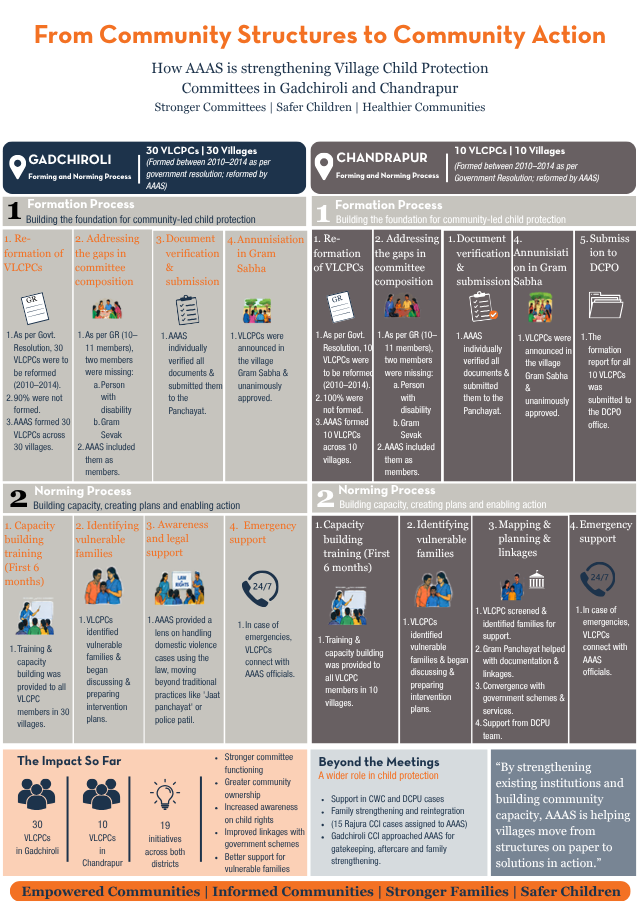
Activation alone wasn’t enough. The program placed real weight on capacity-building and leadership development — helping VLCPC members understand child protection concerns, identify vulnerabilities, discuss cases, and engage confidently with local systems.
This wasn’t a one-time training exercise; it was reinforced through ongoing mentoring and practical, on-the-ground engagement. Members needed more than information — they needed the confidence to act on it.
Over time, the VLCPC became a space where members could work through real situations and practical solutions: connecting a family to a government scheme, supporting a child’s school retention, addressing a protection concern, or approaching the Gram Panchayat directly. Learning moved out of the training room and into the village.
When Awareness Turned into Action
The shift became visible once VLCPC members began applying what they’d learned. In Tulanmendha, VLCPC Chairperson Vaishali Pramod Shende initially attended meetings without fully grasping the committee’s purpose. With program support, she and fellow members developed a clearer sense of their mandate.
During one meeting, the committee discussed a single mother struggling to support her two children — she had no ration card and no stable employment. Rather than simply referring her elsewhere, the committee looked for a local solution. Members identified a vacant support-staff position at the local Zilla Parishad school, recommended her candidature through the Gram Sabha, and helped her secure permanent employment. The committee continues to follow up with the family. The significance here isn’t only the job secured — it’s the shift in how the community responded to vulnerability. The VLCPC moved from identifying a problem to actively helping solve it.
Building a Wider Network of Protection
As VLCPCs grew more active, other community stakeholders evolved alongside them.
For Yamina Bagale, an ASHA worker and VLCPC member, child protection expanded well beyond health-related work. She began facilitating adolescent meetings, discussing children’s rights, identifying vulnerable families, and working with the committee to ensure timely support for children at risk.
Community cadres, too, became key facilitators — supporting family meetings, parenting sessions, Bal Panchayat activities and awareness programmes. The VLCPC was no longer operating in isolation; it was becoming a hub through which different community actors contributed to child protection.
From Awareness to Community-Led Initiatives
The next — and arguably most significant — stage was communities beginning to act on their own initiative.
In Andhali village, the VLCPC organized a Child Safety Week campaign spanning three neighbouring villages. The community itself contributed rice and voluntary donations to fund it. Government departments participated too — the District Child Protection Unit, Child Welfare Committee, Police Department, District Legal Services Authority, Health Department and Education Department — addressing child rights, child marriage prevention, the Protection of Children from Sexual Offences (POCSO) Act, and access to government schemes. Children themselves took part through street plays and cultural programmes. The campaign reached nearly 1,200 community members. This was no longer an awareness programme delivered to the community. It was an initiative owned by it.
Creating Safer Physical Spaces
Community ownership extended to the physical environment children live in. In Bodena village, the VLCPC identified an abandoned open well posing a serious danger to children. The committee raised the issue, mobilized the affected family, submitted a formal request to the Gram Panchayat, and followed up with local authorities. Within two days, a protective wire fence was installed; the Gram Panchayat has since committed to permanently closing the well after the monsoon.
A simple intervention — but one reflecting a real shift in perspective: child protection now includes preventing risk within the community itself, not just responding after harm occurs.
The Emerging Picture Across Both Districts
Across Chandrapur and Gadchiroli, 30 VLCPCs and 30 Bal Panchayats are part of the community-based child protection effort, with 19 initiatives reported across the two platforms. The nature of these initiatives is perhaps more important than the number alone. They span school enrolment and re-enrolment, dropout identification and parental counselling, child marriage and child labour prevention, POCSO and child rights awareness, health and nutrition support, emergency medical assistance, school infrastructure concerns, and responses to migration and local employment challenges.
Taken together, they demonstrate that the role of community institutions is expanding beyond awareness meetings. They are beginning to identify problems, mobilize resources, connect families to services, engage government systems and, in some cases, develop community-led solutions. Bal Panchayat meeting regularity is higher than VLCPC meeting regularity in both districts, indicating that children are also increasingly participating through their own platforms. More importantly, initiatives are emerging from both VLCPCs and Bal Panchayats — suggesting a gradual movement from participation towards action.
What Changed?
This transformation isn’t a story of more meetings or more committees. It’s a story of changing ownership.
The VLCPCs already existed before the program began. What the intervention built was their capacity to function — as active, trusted community institutions. That journey unfolded in four stages:
- Activation — VLCPC members began meeting regularly and understanding their roles.
- Capacity-building — Members developed the knowledge, confidence and leadership skills to act on child protection concerns.
- Awareness — Child rights and protection became part of everyday community conversation.
- Action — Communities began identifying risks, supporting vulnerable families, mobilizing resources and launching their own initiatives.
This progression — from structure to capacity, from capacity to awareness, and from awareness to action — sits at the heart of the Chandrapur–Gadchiroli experience.
From Committees to Community Systems
The experience here shows that community-based child protection isn’t built through a single training session or a single campaign. It takes time. It takes sustained mentoring, local leadership, and a genuine voice for children. It takes frontline workers who recognize their role, and Gram Panchayats and government departments willing to respond. And, at its core, it takes communities that believe protecting children is a collective responsibility.
The lesson isn’t simply that VLCPCs can be activated. It’s that when local institutions are strengthened — and communities are given both the capacity and the confidence to act — statutory structures can evolve into living systems of prevention.
In Chandrapur and Gadchiroli, that transformation is taking shape:
A committee that once struggled to meet is now discussing vulnerable families. A frontline worker is identifying protection concerns before they escalate. A village is mobilizing its own resources for child safety. Children are participating in awareness campaigns. A dangerous well is being secured. A vulnerable mother has found a livelihood. Each action, on its own, may look small. Together, they mark a larger shift — from responding to crises to preventing them; from structures existing on paper to communities taking ownership; and from child protection as an institutional duty to child protection as a collective one. That, ultimately, is where stronger family-based care begins: with communities able to recognize vulnerability, act early, and stand beside families before a child is pushed toward separation.
Author: Kunal Patel, Manager, MEL, Miracle Foundation India
The views expressed in the article are the author’s and do not necessarily reflect those of Miracle Foundation India