
“It is easier to build strong children than to repair broken men.”
-Frederick Douglass, abolitionist and statesman
This timeless insight captures the essence of what we strive for in child care and protection: investing early to build resilience, strength, and well-being in children and families, rather than addressing harm after it has occurred. In the context of child welfare systems, this means prioritizing prevention and family strengthening as the first line of defence against unnecessary separation and institutionalization.
Why prevention matters :
Rising concern over unnecessary child-family separation in India and globally
Across India and globally, many children enter institutional care not because their families have failed, but because support systems have failed their families. When prevention mechanisms are weak and gatekeeping processes lack rigor, children face risks of prolonged separation, loss of familial identity, and diminished opportunities for inclusion and well-being.
Children remain central to India’s social and developmental future. Current demographic trends indicate that children will account for a declining1 share of the national population, making it increasingly important to invest in preventive interventions that protect their well-being and strengthen families. Government-linked statistical reporting indicates that children aged 0–19 constituted about 40.9 percent of India’s population in 2011 and are projected to comprise around 32 percent by 2026, reflecting a major demographic shift but still representing one of the largest child populations in the world. This demographic scale makes child protection a critical policy concern, particularly in a context where children continue to face multiple and overlapping forms of vulnerability.
Child vulnerability in India is shaped not only by direct exposure to abuse or neglect, but also by structural conditions such as poverty, migration, parental illness, disability, family stress, exclusion, and weak access to social protection and support services. In many cases, children who come into contact with formal care systems are not double orphans and without families; rather, they belong to households experiencing severe strain, disrupted caregiving, single parenthood, abandonment or heightened protection risks. This distinction is crucial because it reframes child protection from a narrow concern with rescue and institutional placement to a broader concern with strengthening families before separation occurs. In policy and practice terms, it raises an important question: how many child-family separations could be prevented through earlier, more coordinated, and more sustained support?
The persistence of violence and abuse against children further underlines the urgency of this question. National crime data have shown consistently high numbers of recorded crimes against children, with 129,032 such cases reported in 2017 and 149,404 in 2021. Reporting based on NCRB2 data also noted that 53,874 cases registered in 2021 were under the Protection of Children from Sexual Offences Act, accounting for just over 36 percent of total crimes against children that year3. While official crime figures do not capture the full extent of child maltreatment, emotional abuse, neglect, or unreported violence, they nevertheless indicate the scale and seriousness of child protection risks in the country.
Institutional care often used as default, not last resort
Institutional care continues to occupy a significant place in India’s child protection system, although policy has increasingly moved toward family-based and non-institutional alternatives. Available estimates vary across years and administrative sources, but they consistently show that large numbers of children have lived in Child Care Institutions (CCIs). Some earlier estimates cited more than 9,500 CCIs with over 370,000 children, while later reporting referred to 7,163 CCIs housing over 250,000 children. More recent government data under Mission Vatsalya indicate that the number of children in institutional care declined from 76,118 in 2021–22 to 62,592 in 2024–25, across 3,010 CCIs. In the latest update from the web portal of Mission Vatsalya, there are 5,423 Child Care Institutions (CCIs) registered under the JJ Act, comprising 91,973 children.4 These figures suggest progress in reducing institutional care, but they also highlight the continuing scale of reliance on residential systems and the need to examine why children enter such care in the first place.
The international policy framework is clear that children should grow up, wherever possible, in a family environment, and that poverty alone should never justify separation. The United Nations Convention on the Rights of the Child (UNCRC) establishes the child’s right to protection from violence, abuse, neglect, and exploitation, while recognizing the importance of the family as the fundamental environment for child development. The United Nations Guidelines for the Alternative Care of Children build on this principle by emphasizing the prevention of unnecessary family separation and stating that financial and material poverty should never be the sole justification for removing a child from parental care or placing a child in alternative care. Together, these standards provide a strong normative basis for prevention-oriented child protection systems5.
India’s national framework broadly reflects these global commitments. The National Policy6 for Children recognizes every person below eighteen years as a child, affirms protection as one of its key priority areas, and emphasizes that the family environment is most conducive to a child’s full and harmonious development. More specifically, Mission Vatsalya promotes family-based non-institutional care and is explicitly guided by the principle that institutionalization should be a measure of last resort. These policy directions indicate a clear shift from an institution-centered model of care toward one that is more preventive, community-based, and family-focused.
Families face crisis due to lack of timely support (financial, counselling, disability services)
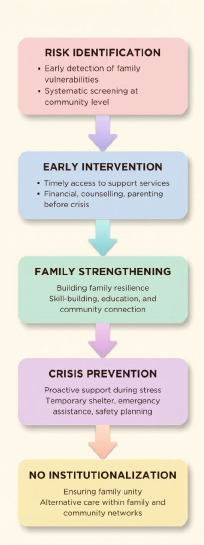
It is within this context that prevention becomes essential. Prevention is required because many pathways into institutional care are not inevitable; they are shaped by risks that accumulate when families do not receive timely assistance. Preventive child protection therefore involves addressing vulnerabilities before they escalate into abuse, abandonment, family breakdown, or placement in alternative care. It is useful to understand prevention across three levels:
- Primary prevention, which seeks to reduce risk across the general population through awareness, social protection, and basic services;
- Secondary prevention, which targets children and families already at heightened risk through early identification, counselling, case management, and concrete support; and
- Tertiary prevention, which focuses on limiting recurrence and supporting recovery after harm or separation has already occurred.
This continuum underscores that prevention is not a single programme activity, but an organizing logic for child protection intervention.
The prevention pathway:
Preventive methods may include early risk identification, family counselling, parenting support, home visits, school retention efforts, economic assistance, disability-responsive services, mental health support, and structured referral pathways linking communities with statutory systems. A related and indispensable concept is gatekeeping, understood as a structured process for ensuring that alternative care is used only when necessary and that decisions about care are made in the child’s best interests. In this sense, prevention and gatekeeping are closely linked: prevention strengthens families before crisis deepens, while gatekeeping ensures that family preservation and support are meaningfully considered before separation is chosen.
From Risk to Resilience: Prevention Pipeline
The role of the child protection system is therefore decisive. A prevention-oriented system must do more than respond after harm occurs; it must identify risks early, mobilize family and community support, coordinate across sectors, and ensure that institutional care remains a last rather than first response. This article is situated within that framework. It argues that reducing unnecessary institutionalization requires a deliberate shift toward prevention, early intervention, family strengthening, and gatekeeping as interconnected components of a child protection system that seeks not only to manage crises, but to prevent them.
Looking at the evidence:
 The article draws on insights from a dipstick study7—a focused, rapid assessment with a small sample of primary caregivers, case managers, and stakeholders—to examine current prevention mechanisms in child care systems. The study8 reveals both gaps and opportunities: where families lack access to timely support, where assessment processes fall short, and where innovative practices are already strengthening family-centred care. The findings are used as practical indicators to show how prevention is functioning at the household and community level, especially in relation to caregiver communication, social support, child protection awareness, and financial stress.
The dipstick study did not seek to produce statistically generalizable findings or a formal impact evaluation. Rather, it was intended to provide an analytically useful snapshot of implementation progress and operational realities within selected programme areas. In keeping with the logic of dipstick and other rapid assessment approaches, the emphasis was placed on identifying recurring patterns, bottlenecks, and perceived areas of effectiveness rather than on estimating causal effects or population-level prevalence.
The findings presented in this article combine results (average percentage) from three prevention programme districts—East Singhbhum in Jharkhand and Vadodara and Mehsana in Gujarat—to provide an overall picture of how prevention is functioning across the study areas. Rather than presenting each district separately, the analysis brings the findings together to identify common patterns in caregiver-child relationships, social support, child protection awareness, and household financial stress. This combined presentation is appropriate because the purpose of the article is not to compare districts, but to examine broader prevention mechanisms and the conditions that support or weaken family-based child protection. District-level differences are noted only where they help clarify important variations in implementation or family vulnerability.
What emerged across the districts:
The majority of families assessed are birth families, with single parents being the most common category followed by birth families with both parents. This indicates that a significant portion of the families are single-parent birth families.
The key findings have been categorized under three thematic areas:
1. Family relationships and caregiver capacity
The findings indicate that family relationships and caregiver capacity are central to the functioning of prevention. A proportion of caregivers reported that they “talk with their child about feelings and thoughts” (54.5%), that their “child feels safe approaching them when something is wrong” (74.9%), and that they try to understand their “child’s emotions and support” them accordingly (50%). Similarly, 74.3% reported that “disagreements with their child are resolved calmly”, while 72.4% indicated that the “level of conflict with the child had decreased” over the previous year9. These indicators suggest that household-level prevention depends not only on external services, but also on the presence of trust, communication, and emotional responsiveness within caregiver-child relationships.
The results also point to variation in caregiver preparedness and confidence. Only 5.2 % of respondents reported “attending training or sessions on parenting, child protection, or child rights within the last year or having some basic training”, while only 39% expressed “confidence in helping their child manage difficult emotions such as sadness or anger”. In addition, 23.4% stated that their “child had shared future plans or aspirations” with them, which may be read as a further indicator of openness and relational security within the household. Taken together, these findings suggest that while some protective practices are present, prevention efforts would be strengthened by more systematic support to caregivers in the areas of parenting confidence, child protection knowledge, and emotionally responsive caregiving.
2.Community support and service linkages
A second pattern in the findings concerns the extent to which families are socially connected and linked to formal or informal support systems. In the previous six months, 57% of respondents reported “receiving help from relatives (childcare, emotional support etc.)”, and 28.6% reported “participation in a community support group” such as a self-help group, cooperative, or parents’ group. In addition, 60.4% described their “relationship with neighbours or the wider community as supportive in emotional, financial, or safety-related terms”. These indicators show that prevention is influenced not only by family capacity, but also by whether families are embedded in support networks that can reduce isolation and respond to emerging concerns.
The findings on child protection knowledge and service awareness reinforce this point. Only 25% of caregivers were able to identify whom they could contact if they suspected that a child was being abused, 52.5 % knew what action they would take if a child disclosed inappropriate touching and 67% (Vadodara) reported awareness of services available locally for children facing abuse, neglect, or exploitation but it was critically low for Mehsana (10%) and East Singhbhum (9.5%). Similarly, correct identification of child neglect, child abuse, and emotional abuse was reported at 30.5%, 41.4%, and 29.3% respectively. These findings can be interpreted as indicators of preventive readiness: families are better positioned to seek help early when they recognize risk and understand how to access support. Where social networks and service linkages are weak, prevention is likely to remain reactive rather than anticipatory.
3.Household stress and material vulnerability
The third major domain concerns household stress and material vulnerability. 56.8 % of respondents reported that their family had experienced financial stress in the previous six months affecting food, rent, or schooling. 78 % indicated that their family frequently had sufficient food for all members, while 52.2% reported relying on coping mechanisms such as borrowing money, reducing meals, or selling assets during financial difficulty. Compared to 12 months earlier, 13.4% continued to report dependence on these coping strategies. These findings suggest that a substantial proportion of households remain under economic strain, which may undermine their ability to provide stable and consistent care for children.
Access to concrete support also appeared uneven. 62.6% of families reported receiving benefits from government schemes such as ration support, pensions, job cards, or livelihood assistance, while 27.1% expressed confidence in managing future expenses or emergencies. These findings reinforce the importance of understanding prevention not only as a behavioural or educational intervention, but also as a material and structural one. Concrete economic support is increasingly recognized as a critical component of family strengthening because it helps families meet basic needs, reduce stress, and create safer environments for children.
What the findings mean:
Taken together, the three themes suggest that prevention is not a single intervention but a system condition produced through stronger family relationships, better social support and service linkages, and reduced household stress. The findings imply that child protection systems are likely to be more preventive when caregivers are emotionally equipped, when families are socially connected and aware of services, and when material vulnerabilities are addressed early. This interpretation aligns closely with family-strengthening models, which view child safety as emerging from the interaction of protective factors rather than from surveillance or crisis response alone.
These findings also have practical implications for program design. First, parenting and caregiver support should be strengthened as a preventive intervention, not treated as an optional add-on. Second, community-level actors and referral systems should be reinforced so that families can access help before situations deteriorate. Third, economic and concrete support should be integrated into prevention strategies rather than managed separately from child protection concerns.
In this sense, the discussion reinforces the central argument of the article: prevention requires systems that support families early, relationally, and materially. The results do not merely describe conditions within households; they point to the wider institutional task of building a child protection system capable of recognizing vulnerability early and responding in ways that preserve family life while protecting children’s rights.
From evidence to action : Key Recommendations
- Strengthen caregiver support through structured parenting and family-strengthening programmes at district and community levels.
- Build stronger community linkages so families can access informal help, local services, and entitlements more easily.
- Address household financial stress directly, since economic hardship weakens caregiving stability.
- Ensure prevention programmes include both awareness-building and practical assistance, rather than information alone.
- Adapt implementation to local district realities while maintaining a common child protection framework and referral pathway.
- Focus on family strengthening as a preventive strategy, not only on responding after problems arise.
- Promote non-violent caregiving and emotional security through parent education, home visits, and community engagement.
- Improve coordination between government departments, community organisations, and service providers so families do not fall through gaps.
- Train frontline workers to identify early signs of family stress, caregiving strain, and child vulnerability before situations escalate.
- Build monitoring systems that track not only service delivery, but also whether families experience stronger support and reduced vulnerability.
Conclusion
The findings of this study reinforce the argument that prevention in child protection must be understood as a family-strengthening and systems-strengthening agenda rather than only as a response to crisis. Across the three domains examined—family relationships and caregiver capacity, community support and service linkages, and household stress and material vulnerability—the results show that children are more likely to remain safe within families when caregivers have supportive relationships with children, when families are connected to social and formal support networks, and when basic material needs are more secure.
The study also suggests that prevention cannot be reduced to awareness alone. Effective prevention requires a broader protective environment in which caregivers are confident, children can communicate distress, communities can offer practical support, and households have access to concrete assistance in times of need.
For policy and practice, the implications are clear. Prevention-oriented child protection systems must invest simultaneously in relational support, community-based service linkages, and material assistance to families under stress. The article therefore concludes that prevention should be positioned not as a peripheral activity within child protection, but as one of its central organizing principles. It is well said by Dr. Melissa Merrick, President & CEO, Prevent Child Abuse America that “Prevention is possible. With the right policies, investments, and community support, every family can thrive. Hope is what inspires us to dream of a better future, and prevention is what turns those dreams into reality.”
- https://www.mospi.gov.in/uploads/publications_reports/publications_reports1758786985700_34231a75-985a-4359-8592-2bbe250ad169_CompletePublication_CH2025.pdf
- Source- https://www.ncrb.gov.in/uploads/files/CrimeinIndia2024-VolumeI1.pdf
- Source- https://indianexpress.com/article/india/crime-against-kids-a-third-still-under-pocso-8119689/
- Source- https://missionvatsalya.wcd.gov.in/)
- Source- https://www.sos-childrensvillages.org/getmedia/4972cb2e-62e1-4ae8-a0bc-b0e27fe3ea97/101203-UN-Guidelines-en-WEB.pdf
- Source- https://www.pib.gov.in/newsite/PrintRelease.aspx?relid=118660®=48&lang=2
- This is an internal study conducted by Miracle Foundation India in East Singhbhum district (Jharkhand) and Vadodara and Mehsana districts (Gujarat), where the prevention program is being implemented.
- The Lot Quality Technique (LQAS) based dipstick study aims to assess the minimum standard of performance across five key domains of family well-being, using caregiver-level data to classify whether each district (lot) meets acceptable performance thresholds. Each district was treated as a lot, and 19 samples per lot were randomly selected based on predefined family selection criteria.
It also seeks to shed light on implementation challenges and barriers within Family Strengthening (FS) and Family-Based Alternative Care (F-BAC) programming, with a focus on understanding the factors that enable families to care for and protect children within the home, as well as the persistent gaps that contribute to child - This indicates that families who have been part of the intervention for more than one year have been able to reduce conflict situations between themselves and their children