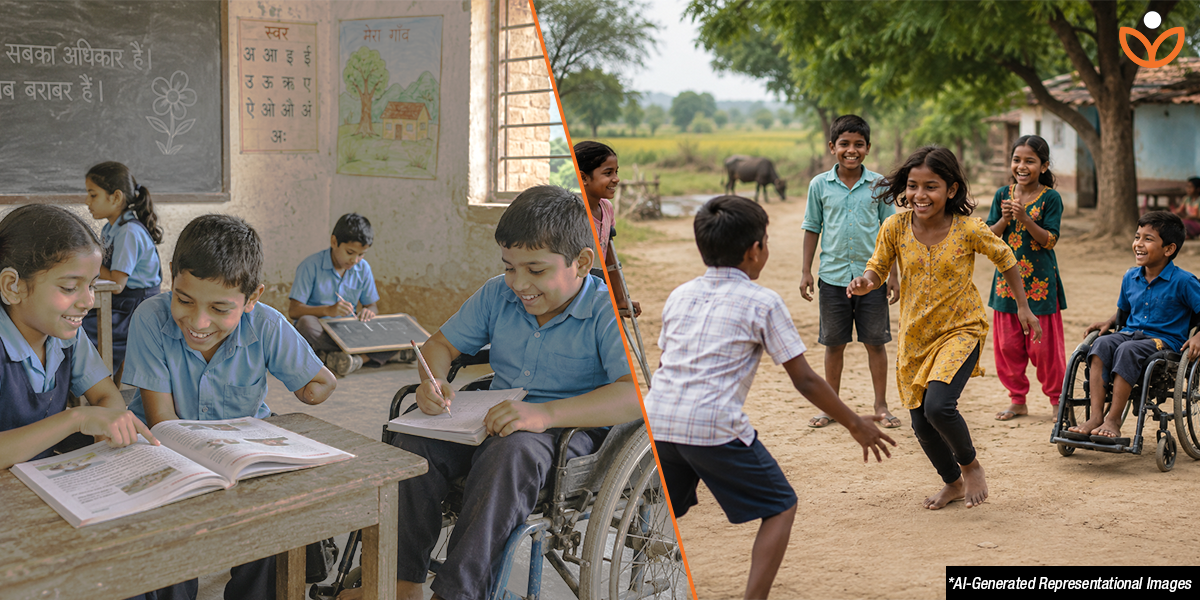
A child can be present in a classroom and still remain excluded from learning, participation, and dignity. That gap between formal inclusion and meaningful inclusion sits at the heart of child protection practice, especially for children with disabilities.
The memory of a single sentence spoken by a government school teacher in 2016 still remains vivid in my mind. It was directed at a child with special needs.
“Arey! Madam, ye kam dimag ka hai. Ise kuchh nahi aata.” (Ma’am, he is mentally challenged. He does not know anything.)
I was at the government formal school to conduct an assessment. When I explained the purpose of my visit, the teacher agreed to cooperate. He also shared, with evident concern, some of the challenges he faces: many children come from low-income households, some parents have limited literacy, attendance can be irregular, and teachers carry heavy administrative responsibilities. These are real constraints that affect classroom practice, yet they don’t fully account for why some children are left without appropriate learning support.
While conducting the assessment, my eyes were drawn to a boy standing outside the classroom, quietly staring at me. I tried speaking to him, but he did not respond to any of my questions; he only smiled. I invited him into the classroom, offered him a chair, and handed him the assessment paper so that he would not feel left out.
I looked at the boy sitting beside me. He was still smiling. He was a child with special needs (CWSN).
Classmates told me that he was enrolled in Grade 8 but unable to recognize or write even a single Hindi alphabet. They also shared something heavier: after his mother’s death, his father forced him to take on most household responsibilities — cooking meals, managing chores, and working in the fields alongside him. School became irregular, then stopped. When his father saw no academic progress, he withdrew the boy completely and engaged him in agricultural work instead.
When I spoke again with the teacher, his helplessness showed: “It is difficult for me alone to cater to every child’s needs. Still, I allow him to come to school and have kept his name enrolled.” His words sounded less like responsibility and more like an act of charity.
I left the school with a heavy mind and a string of urgent questions.
“Is this what inclusion means — merely keeping a child’s name on the roll or providing a ramp to the building?”
“How inclusive is a system that stops believing in a child before the child even begins?”
These questions matter more now because the legal and policy environment in India has evolved substantially.
Over the past decade, India has made significant progress towards fostering inclusion and strengthening the rights of children and persons with disabilities. Key legislative and policy developments, such as the Rights of Persons with Disabilities Act, 2016, the Mental Healthcare Act, 2017, and the Accessible India Campaign, have helped create greater opportunities for participation and inclusion in mainstream society. During the same period, the child protection sector has also witnessed important reforms through initiatives such as the Juvenile Justice (Care and Protection of Children) Act, 2015, and Mission Vatsalya, 2022. Together, these efforts reflect a growing commitment towards ensuring that every child grows up in a family and community-based environment rather than in institutional care.
However, the separate evolution of disability and child protection frameworks has left them insufficiently aligned. This fragmentation creates legal and policy gaps and inconsistencies that, in practice, leave children with disabilities vulnerable—falling between multiple, uncoordinated systems instead of receiving coherent protection and support.
The legal change alone does not change classroom practice or family decisions. My encounter at the school exposes common gaps between policy intent and on-the-ground realities: inadequate teacher training on inclusive pedagogy, lack of individualized learning supports and assessment, limited intersectoral coordination (health, social welfare, education), and poverty-driven pressures that push children into work. These gaps mean a child can be formally “included” in the roll book but effectively excluded from learning, participation, and growth.
Understanding Inclusion in Child Protection
Children with disabilities face a higher risk of neglect, violence, abandonment, institutionalization, and exclusion. (Violence Against Disabled Children-UNICEF, 2005) Many grow up without access to education, healthcare, assistive services, emotional support, or community participation. In some cases, families struggle due to poverty, stigma, lack of awareness, or the absence of support systems. A UN-backed review published in The Lancet (2012) found that children with disabilities were 3.7 times more likely to experience violence, 3.6 times more likely to experience physical violence, and 2.9 times more likely to experience sexual violence. In India, only 61% of children with disabilities aged 5–19 years receive education (Census 2011). 27% never attended school.
Another relevant fact from the Annual Report 2023–24 (Department for Empowerment of Persons with Disabilities, Government of India) is that 50% of Persons with Disabilities (PwD) in the age group 15–59 years are employed, while only 4% of children with disabilities (below working age) are receiving formal skill-development, vocational exposure, or training support that would prepare them for eventual employment.
This stark contrast highlights a critical concern: early exclusion in school and skill-building stages often leads to delayed or lost opportunities for employment later in life.
When child protection systems fail to recognize disability, children can become invisible within programs and policies. This invisibility affects:
- Access to family strengthening services
- Participation in education and community activities
- Case management and rehabilitation support
- Mental health and psychosocial care
- Emergency and crisis response mechanisms
- Transition support for adolescents and young adults
Inclusion means ensuring that children with disabilities are not treated as “special cases” outside the system, but as equal participants within it.
Why Inclusion Matters
- Every Child Has the Right to Family and Care
Children with disabilities are often overrepresented in institutional care settings. Families may feel unsupported or overwhelmed, especially where services are limited. Strengthening families through counselling, financial assistance, disability support services, and community-based care can prevent unnecessary separation.
A child’s disability should never become the reason for losing family care.
- Protection Risks Are Higher
Research globally shows that children with disabilities are more vulnerable to abuse, exploitation, bullying, and neglect. Communication barriers, dependency on caregivers, and social isolation can increase these risks.
Protection systems must therefore become disability-responsive by:
- Training frontline workers
- Creating accessible reporting mechanisms
- Adapting safeguarding practices
- Ensuring inclusive case management
- Participation Builds Confidence and Agency
Children with disabilities are often spoken for, rather than listened to. Inclusion requires creating safe spaces where children can express their opinions, share experiences, and participate in decisions affecting their lives. Child participation is meaningful only when all children are included.
Barriers to Inclusion
Despite policy progress and growing awareness, several challenges remain within the child care and protection ecosystem:
- Identification and assessment: children are frequently labelled without context-sensitive assessment that can distinguish disability, trauma, interrupted schooling, bereavement, malnutrition, language barriers, or deprivation-driven learning delays.
- Social Stigma: Negative attitudes and misconceptions about disability continue to isolate children and families.
- Lack of Accessible Services: Schools, health facilities, community centres, and protection services are often physically or socially inaccessible.
- Limited Data: Many programs do not adequately capture disability-disaggregated data, making children invisible in planning and budgeting.
- Insufficient Capacity: Caseworkers, caregivers, teachers, and community volunteers may lack training on disability inclusion and child rights.
- Weak Coordination: Disability services and child protection systems frequently operate separately, reducing holistic support for children.
- Monitoring: Across child protection, education, and related sectors, monitoring frameworks commonly focus on enrolment, attendance, or case numbers, while participation, learning progress, safety, belonging, and well-being are not yet consistently captured or reported.
Building Inclusive Child Protection Systems
Creating inclusive systems requires commitment at every level — family, community, service providers, institutions, and government.
- Strengthening Families: Families need emotional, social, and economic support to care for children with disabilities within nurturing home environments.
- Inclusive Community Mechanisms: Village child protection committees, community groups, and local leaders should actively identify and support children with disabilities.
- Accessible Services: Programs must ensure:
- Barrier-free infrastructure
- Inclusive communication formats
- Sign language or alternative communication support
- Flexible service delivery
- Capacity-Building of Frontline Staff: Frontline staff should be trained in disability-sensitive approaches, trauma-informed care, and inclusive safeguarding practices.
- Leveraging District Institutes of Education and Training (DIETs): DIETs are responsible for teacher training in inclusive education at the district level. Many states are now training teachers on working with children with disabilities. Partner with DIETs to include child consultation modules in teacher training.
- Integrating with Integrated Education for Disabled Children (IEDC) Scheme: The IEDC scheme (now part of Samagra Shiksha Abhiyan) provides support for children with disabilities in regular schools, including assistive devices, special teachers, resource centres, and barrier-free infrastructure). Use IEDC schools as access points for consulting children with disabilities.
- Using Accessible India Campaign (Sugamya Bharat Abhiyan): The Accessible India Campaign focuses on building barrier-free environments, accessible transportation, and inclusive public spaces. Consult children with disabilities on accessibility needs in schools and communities.
- Listening to Children: Children with disabilities should not be passive recipients of services. They must be active participants in consultations, assessments, and program design — using accessible formats (visual aids, sign language, plain language), involving them in feedback sessions, and ensuring their voices shape decisions about their own care and education.
- Better Data and Evidence: Monitoring systems should include disability indicators to understand exclusion and improve program effectiveness.
Moving from Sympathy to Inclusion
Children with disabilities do not need pity. They need opportunities, accessibility, acceptance, and systems that recognize their potential. True inclusion happens when children can participate equally in school, family life, recreation, decision-making, and community spaces — without discrimination. The child care and protection sector must move beyond viewing disability as a welfare issue. It is a child rights issue, a protection issue, and a social justice issue.
Conclusion
An inclusive society is reflected in how it supports its most vulnerable children. When children with disabilities are excluded, communities miss opportunities to become more compassionate, equitable, and resilient.
The way forward is not the expansion of institutions; rather, it is a decisive shift toward community-based services and family strengthening. For children currently in institutions, we must prioritize safe, supported pathways back to families and communities. Services and support should move out of institutions and reach children where they are – in their families and communities.
“Inclusion Matters” is not just a slogan. It is a reminder that every child, regardless of ability, deserves protection, dignity, participation, and opportunities to thrive.
Author: Poonam Rai, Lead-Monitoring, Evaluation and Learning, Miracle Foundation India
The views expressed in the article are the author’s and do not necessarily reflect those of Miracle Foundation India.