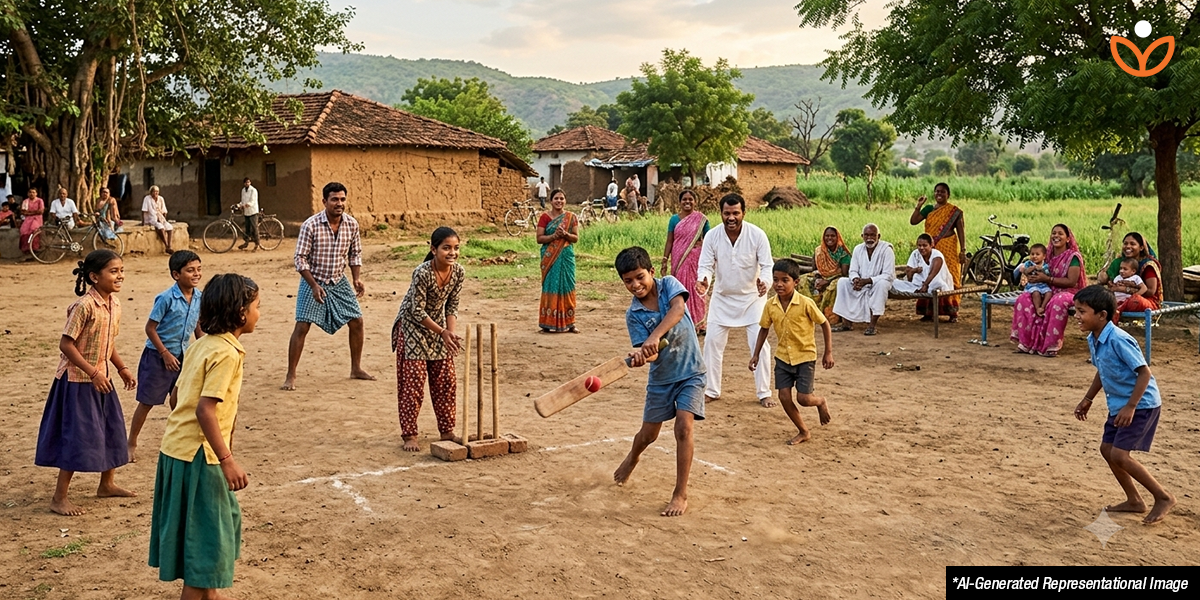
“It takes a village to raise a child.” This timeless proverb has never been more relevant. Every day, communities across India are proving that child protection is not solely the responsibility of government institutions or child welfare professionals—it is a shared responsibility that begins where children live, learn, and grow.
At Miracle Foundation India, we believe that sustainable child protection starts with empowered communities. When local leaders, teachers, frontline workers, parents, youth, and Panchayat representatives come together, they create a safety net that identifies vulnerabilities early, supports families before crises escalate, and ensures that every child has the opportunity to thrive within a caring family.
Village-Level Child Welfare and Protection Committees (VLCWPCs) and Ward-Level Child Welfare and Protection Committees (WLCWPCs) are at the centre of this vision. These community-based platforms bring together diverse stakeholders to identify risks, promote children’s rights, strengthen families, and connect vulnerable children with essential services.
To understand how these committees are strengthening community-based child protection, Miracle Foundation India assessed the functionality of VLCWPCs and WLCWPCs across seven states. The findings reveal an encouraging story of growing community ownership, stronger local action, and an exciting opportunity to deepen the institutionalization of child protection within local governance systems.
 Community Action at Scale: Strengthening Child Protection Across Seven States
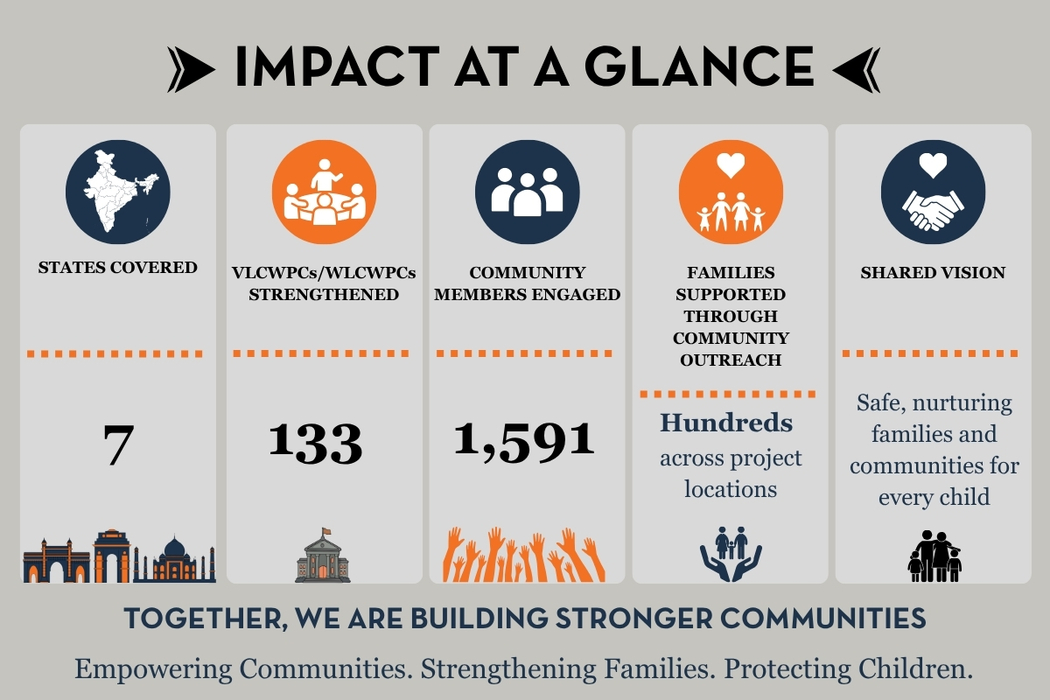
Today, Miracle Foundation India supports a growing network of 136 Village-Level and Ward-Level Child Welfare and Protection Committees, engaging more than 1,700 community members across Bihar, Gujarat, Jharkhand, Karnataka, Maharashtra, Telangana, and Tripura. These committees represent far more than numbers. They bring together Panchayat representatives, Anganwadi Workers, ASHAs, teachers, police representatives, health workers, Self-Help Groups, youth volunteers, and community leaders who collectively work to create safer environments for children.
Building Communities That Protect Children
The assessment looked beyond the formation of committees and explored how they are contributing to child protection in their communities.
Rather than asking “Do committees exist?“, the assessment focused on a more meaningful question:
“How are communities working together to keep children safe?”
The review examined key dimensions of community functionality, including:
- Regular committee meetings
- Community-led child protection initiatives
- Family visits and early identification of vulnerable children
- Linkages with government schemes and services
- Community participation through Gram Sabha
- Coordination with local institutions
- Capacity-building of committee members
- Progress towards integrating child protection into local governance
This approach reflects the belief that effective child protection is measured not only by structures but by collective community action.
Communities Are Taking Ownership
One of the strongest messages emerging from the assessment is the growing sense of community ownership. Across project locations, VLCWPCs are increasingly serving as platforms where community members come together to discuss child protection concerns, identify vulnerable families, facilitate access to social protection schemes, and support children before situations become critical.
Many committees have established regular meeting processes, maintained records, strengthened coordination with frontline service providers, and conducted family outreach to ensure that children and caregivers receive timely support.
These efforts demonstrate the important role communities play in preventing family separation and promoting safe, nurturing family environments.
Learning from States Leading the Way
Every state contributes unique experiences, demonstrating that there is no single model for building effective community child protection systems. Together, these experiences offer valuable lessons that can be shared and adapted across the country.
States such as Jharkhand and Bihar are steadily strengthening community-based child protection mechanisms through capacity-building, regular engagement, and expanding collaboration with local stakeholders. As these committees continue to mature, they are well positioned to deepen community participation and further strengthen child protection outcomes.
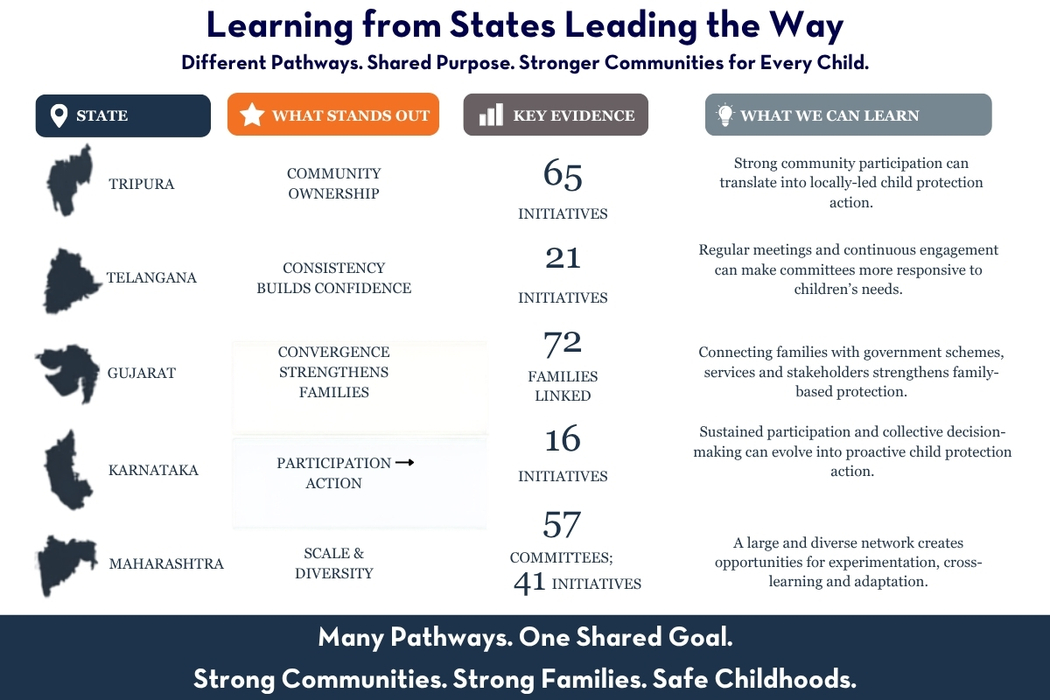
Across five states namely Tripura, Telangana, Gujarat, Karnataka and Maharashtra, diverse experiences demonstrate that there is no single pathway to building strong community child protection systems. Tripura highlights the power of community ownership through 65 locally-led initiatives, while Telangana shows how consistency and regular engagement can build responsive committees. Gujarat demonstrates the value of convergence, with 72 families linked to government schemes and services, and Karnataka shows how sustained participation can translate into proactive community action through 16 initiatives. Maharashtra, with 57 committees and 41 initiatives, brings the strength of scale and diversity, creating opportunities for cross-learning and adaptation. Together, these experiences highlight how ownership, consistency, convergence, participation and collaboration can strengthen families, empower communities and create safer environments where every child can grow and thrive.
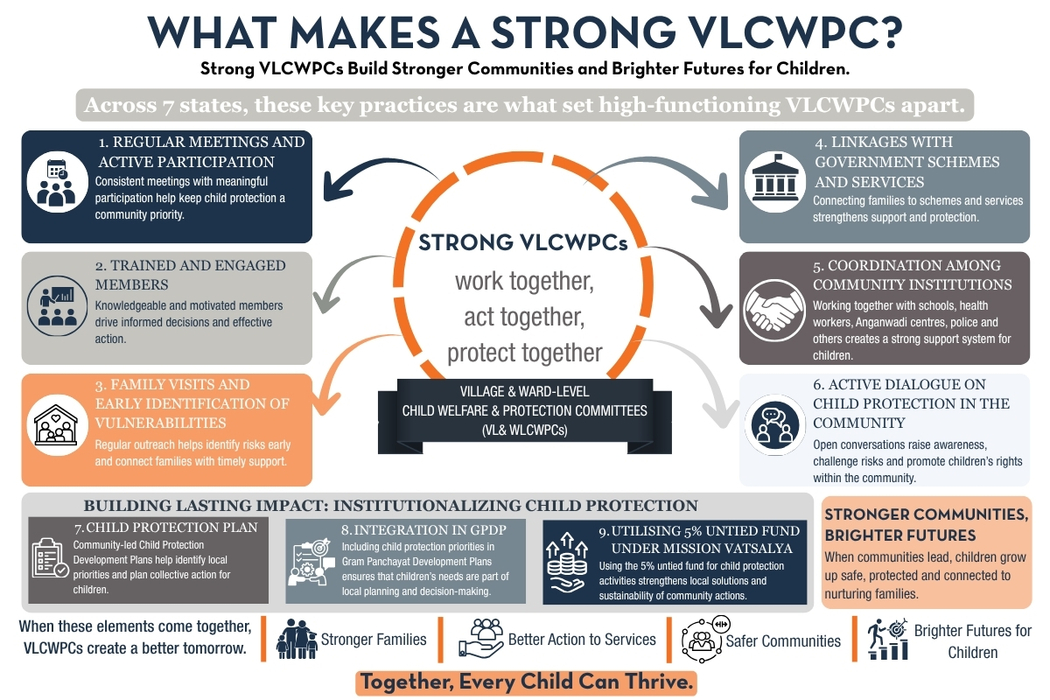
What Makes a Strong VLCWPC?
Strong VLCWPCs are built on a combination of regular meetings, active and trained members, meaningful family engagement, service linkages and strong community coordination. Family visits and early identification of vulnerabilities help communities respond proactively, while connections with government schemes and services ensure families can access the support they need. Regular dialogue on child protection, participation of local institutions and continued capacity-building further strengthen the role of VLCWPCs as community platforms. Together, these practices help strengthen families, improve access to services, promote collective responsibility and create safer, more nurturing environments where children can grow and thrive.
The Challenges Along the Journey
While these practices demonstrate what helps VLCWPCs become stronger and more responsive, the assessment also highlights that building sustainable, community-owned child protection systems takes time.
Across states, committees are at different stages of maturity. Some are already leading local initiatives, while others are still strengthening regular participation, clarity of roles and the ability to translate discussions into action.
Key challenges include:
- Sustaining participation: Members often balance committee responsibilities with livelihoods and other professional responsibilities.
- Building capacity: Continued support is needed to strengthen members’ understanding of child protection, vulnerability identification and referral mechanisms.
- Moving from meetings to action: Some committees require further support to translate discussions and plans into community-led initiatives.
- Strengthening convergence: Accessing schemes and services often requires coordination with multiple government departments and local institutions.
- Deepening community ownership: Sustaining committees beyond programme support requires greater integration with local governance and stronger community leadership.
These challenges are not barriers to progress; rather, they represent the next stage in the journey. Continued capacity-building, stronger convergence and deeper integration with local governance can help VLCWPCs and WLCWPCs evolve from functional committees into sustainable, community-owned child protection systems.
The Next Chapter: From Functionality to Institutionalization
The assessment also highlights an exciting opportunity for the future.
As committees become increasingly active within their communities, the next phase is to further embed child protection within local governance systems.
This includes:
- Integrating child protection priorities into Gram Panchayat Development Plans.
- Developing community-led Child Protection Development Plans.
- Strengthening participation in Gram Sabha and local planning processes.
- Leveraging government mechanisms, including Mission Vatsalya, to support community child protection initiatives.
- Building stronger convergence between Panchayats, frontline workers, schools, health systems, and child protection institutions.
This evolution represents a natural progression—from establishing community platforms to creating sustainable, community-owned child protection systems that continue to protect children for years to come.
A Shared Vision for Every Child
Child protection cannot succeed in isolation. It flourishes when communities become active partners in ensuring that every child is safe, heard, and connected to a loving family.
The assessment demonstrates that across India, communities are increasingly embracing this responsibility. Every committee meeting, every family visit, every child connected to essential services, and every community discussion on child protection contributes to building a stronger protective environment.
While every state is on its own unique journey, the collective direction is clear: communities are becoming more informed, more engaged, and more confident in protecting children.
At Miracle Foundation India, we remain committed to strengthening these community systems because lasting change happens when communities themselves become champions of children’s rights.
Together, we move closer to our vision of “A family for every child in our lifetime.“
Author: Kunal Patel, Manager, MEL, Miracle Foundation India
The views expressed in the article are the author’s and do not necessarily reflect those of Miracle Foundation India