
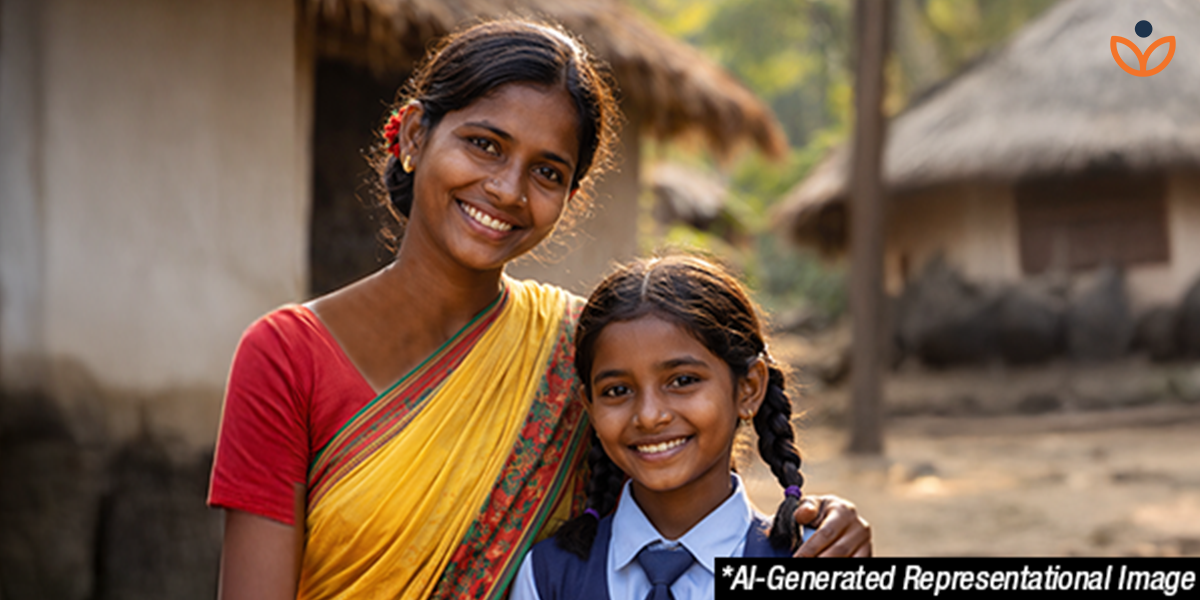
Every morning, 14-year-old Niyati (name changed) walks to school, something that once felt out of reach.
In a village in East Singhbhum, Jharkhand, Niyati and her mother are rebuilding their lives with quiet determination. Niyati lost her father when she was very young, and since then, her mother, like many women heading households alone, has worked as a daily wage labourer, earning just enough to get through each day, but never enough to feel secure.
When work became irregular, stability began to slip away. Niyati’s schooling was interrupted, and without a steady income or essential documents, the family fell deeper into distress. As options narrowed, the possibility of institutional care began to loom, not because her mother lacked care, but because poverty left the family with few choices.
That is when timely, family-centred support made the difference. In Jharkhand, Miracle Foundation India, along with its partner organisation, Bal Kalyan Sangh, works to identify and support families long before separation becomes a reality, strengthening them so they do not slip further into crisis. The team visited the family, listened carefully to their needs, and tailored support to build a sustainable, long-term livelihood. With this guidance, the Panchayat Mukhiya and the Gram Rojgar Sewak facilitated the construction of an animal shed, while the Agriculture Department provided 5 goats, together establishing a sustainable source of income. Niyati’s mother was also linked to the Didi Badi Yojana through which she received seeds to begin small-scale farming.
At the same time, the family was supported in securing essential documents, opening doors to government schemes and social protection. Niyati was linked to the Sponsorship Scheme, ensuring her education would not be interrupted again. And then came the moment that mattered most: Niyati’s return to school. She now attends school regularly and aspires to become a teacher, while her mother earns a steady income without the fear of separation.
This is what prevention looks like. When families are supported early with livelihoods, education, and social security, combined with robust community protection systems, children don’t need to be separated to be protected. They can grow, learn, and dream right where they belong: with their families.