
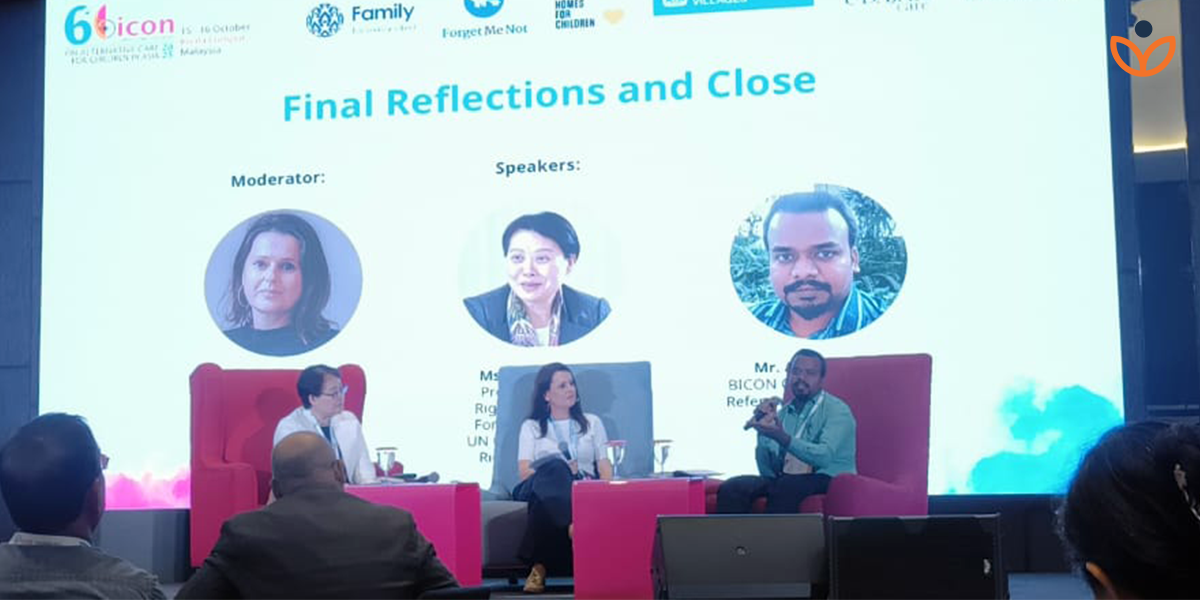
I recently participated in the 6th Biennial International Conference on Alternative Care for Children in Asia, held on October 15–16, 2025, in Kuala Lumpur, Malaysia. Organized by Family for Every Child, Forget Me Not Australia, Hope and Homes for Children, SOS Children’s Villages, Udayan Care, and UNICEF Malaysia, the conference brought together government officials, practitioners, researchers, civil society leaders, and a strong delegation of care-experienced youth from across the region.
The theme for BICON 2025, ‘Care Reform for Children: Building Inclusive Societies, Resilient Families, and Thriving Children, set the tone for meaningful dialogue and collaboration focused on strengthening family-based care and reimagining child protection systems in Asia. A major highlight this year was the participation of 34 care-experienced leaders from 8 countries (India, Nepal, Sri Lanka, Bangladesh, Malaysia, Pakistan, Thailand, and Vietnam), who contributed as facilitators and co-panellists, bringing authenticity and lived insight to every conversation.
Representing Miracle Foundation India, I had the opportunity to speak during the Care-Experienced Youth Sharing Session and participate in a panel discussion. I shared perspectives on the challenges faced by care-experienced youth and highlighted the positive steps being taken towards their enablement
Based on my observations and reflections at BICON 2025, it became clear that we at Miracle Foundation India have a powerful opportunity to deepen our engagement with care-experienced youth. The conversations, youth-led sessions, and region-wide learning reaffirmed that young people transitioning out of care require intentional, long-term, and holistic support systems. Drawing from the insights shared by practitioners, governments, and care-experienced youth themselves, here is how I believe that Miracle Foundation India can strengthen its approach to enabling care-experienced youth across the programs and partnerships.
1. Institutionalize Aftercare as a Core Program Pillar
Insight: BICON 2025 emphasized that aftercare is not a privilege — it’s a right. Care-experienced youth need structured, long-term support to transition successfully into independent life.
Proposed Actions:
● Integrate a dedicated “Aftercare Program” within the Youth vertical, focusing on housing, education, employment, and emotional well-being.
● Develop Individualized Transition Plans (ITPs) for each young person exiting care.
● Collaborate with State Child Protection Units to ensure every eligible care-experienced youth is registered under Aftercare Schemes.
● Create a “Care-Experienced Youth Fund” or resource pool to support urgent needs like accommodation, documentation, and skill training.
2. Build a Strong Care-Experienced Youth Network
Insight: BICON showed how peer networks build resilience, confidence, and a sense of belonging.
Proposed Actions:
● Facilitate the creation of a “Care-Experienced Youth Collective” — a national or regional network where youth can connect, provide peer support, mentor each other, and influence change collectively.
● Host quarterly leadership circles (both online and offline) for care-experienced youth to share experiences and opportunities.
3. Focus on Mental Health and Psychosocial Well-being
Insight: Emotional safety is as vital as financial independence. Many care-experienced youth struggle with trauma, anxiety, or isolation post-transition.
Proposed Actions:
● Embed trauma-informed practices into all youth and aftercare programs.
● Develop a mental health support ecosystem — including access to trained counsellors, peer supporters, and helpline resources.
● Train staff and mentors in psychological first aid and youth-sensitive communication.
● Celebrate “Wellness Weeks” or “Healing Circles” for care-experienced youth to normalize conversations around mental health.
4. Enhance Livelihood and Life Skills Readiness
Insight: Sustainable independence requires both hard and soft skills.
Proposed Actions:
● Strengthen partnerships with vocational training / professional courses institutes, CSR programs, and digital learning platforms.
● Introduce financial literacy, digital literacy, and career planning modules tailored for care-experienced youth.
● Establish mentorship programs pairing care-experienced youth with professionals from Miracle Foundation India’s networks (alumni, volunteers, corporate mentors).
● Support internship-to-employment pathways through partnerships with youth-friendly employers.
5. Promote Youth Participation in Policy and Program Design
Insight: Youth at BICON 2025 called for formal mechanisms for participation in decision-making.
Proposed Actions:
● Create a Youth Advisory Board made up of care-experienced individuals to advise on program strategies, campaigns, and advocacy initiatives.
● Include at least one care-experienced representative in every external delegation (conferences, policy meetings, etc.).
● Train youth in communication and leadership to represent their peers effectively.
● Document and publish youth-led research or position papers to influence policy discourse.
6. Improve Transition and Case Management Systems
Insight: Smooth transitions require coordinated planning between homes, families, and systems.
Proposed Actions:
● Develop a standardized transition checklist for care-leaving preparation (documentation, housing, employment, psychosocial readiness).
● Train social workers and caregivers to prepare youth for independent living two years before they exit care.
● Track care-experienced youth for at least two years post-transition to assess well-being and provide continued support.
7. Influence Systemic Change
Insight: Change must go beyond individual programs to influence national and state-level systems.
Proposed Actions:
● Collaborate with MWCD (Ministry of Women and Child Development) and State Governments to strengthen the Aftercare component under the JJ Act.
● Partner with Family for Every Child, UNICEF, and Udayan Care for regional advocacy on the rights of care-experienced youth.
● Contribute to a National Aftercare Framework, ensuring funding, monitoring, and accountability.
● Use storytelling and media campaigns to amplify lived experience narratives and shift public perceptions about children and youth with lived experience..
8. Strengthen Internal Capacity and Partnerships
Insight: Effective care-experienced youth work requires well-trained staff, collaboration, and consistent funding.
Proposed Actions:
● Train program staff in care-experienced youth engagement, trauma care, and youth leadership facilitation.
● Build partnerships with corporates, universities, and NGOs for scholarships, mentorships, and resource support.
● Establish an internal care-experienced youth task force to monitor progress, collect feedback, and adapt strategies.
The Bigger Vision
By acting on these learnings, we can move closer to a future where every child and every care-experienced young person has the support, stability, and opportunities they need to thrive. The vision is not about any single organization becoming a leader—it is about building systems and communities where young people leaving Child Care Institutions are never left behind.
BICON 2025 reinforced that real progress happens when children and youth are at the centre of care reform, shaping the policies, programs, and practices that affect their lives. Our collective responsibility is to ensure they have the tools, networks, and enabling environments to build strong, fulfilling futures.
As the conference so powerfully reminded us: “We can’t change their past, but we can help build their future.” Every young person deserves trust, opportunity, and the right support at the right time—and creating that environment begins with all of us. True inclusion is not about inviting youth into spaces; it is about listening to them, learning with them, and partnering with them at every step.
My journey with BICON began in 2023, which was my first global platform and a moment that strengthened my belief that youth voices are finally being heard. This year’s BICON deepened that conviction. It reaffirmed the importance of creating spaces where care-experienced young people can connect, influence change, and support one another. Inspired by these conversations, I am now working to build a care leaver network in my state—so that more young people can access the community, opportunities, and confidence they deserve.
Author: Albert Justin, Assistant Manager-Youth Program -Miracle Foundation
The views expressed in the article are the author’s and do not necessarily reflect those of Miracle Foundation India.