‘It takes a village to raise a child.’ – African Proverb
This age-old saying emphasises that raising a single child is not a solitary task, but a collective effort of the entire community. In this article, we’ll discuss convergence and how collective efforts, through shared goals, can help us achieve Mission Vatsalya. Children and young adults without a stable family support system often lack the emotional and social safety net needed to thrive. Many ministries and departments collaborate to solve problems together rather than in parallel.
The Convergence Matrix: Translating Policy into Practice
Mission Vatsalya introduced a structured Convergence Matrix to achieve desired outcomes in child welfare and protection. This visual tool maps ministry, department, and program collaboration across governance levels to deliver coordinated results for children and families. The matrix details domains (as shown in Figure 1) that a child is surrounded by, which are aligned across multiple administrations, from the community to the national level.
- Intra Ministry Convergence – Mission Saksham, Mission Shakti, CARA
- Inter Ministry Convergence – Across different ministries impacting lives of children
- Convergence with States/UTs – State Police, State Finance, Department of Women and Child Development, Social Justice and Empowerment, Civil Society Organizations in this fold, take recommendations from the state governments
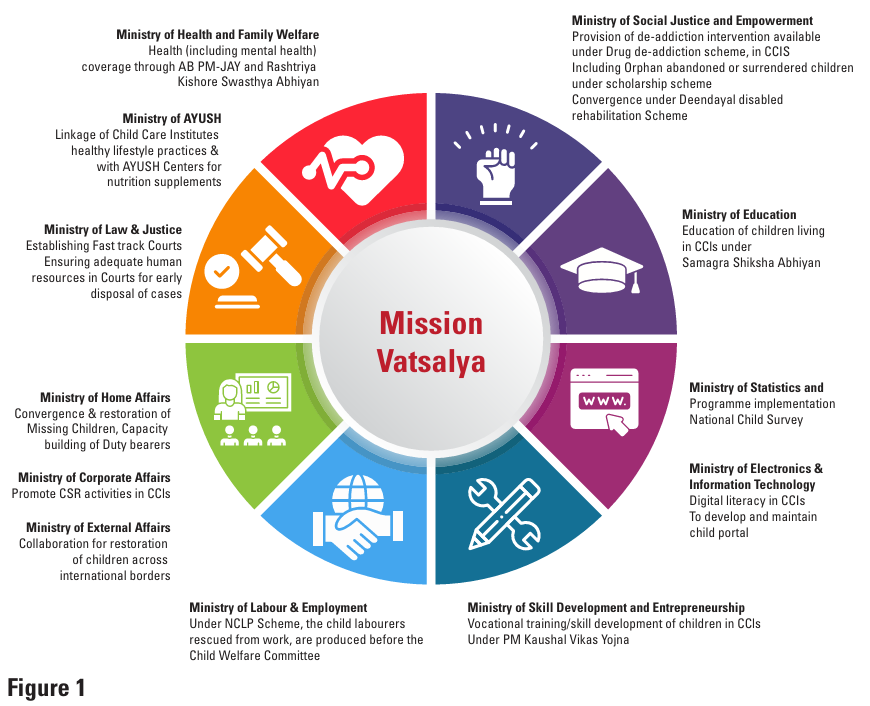
The Matrix simplifies complex systems, aiding field practitioners in planning interventions for children and families. It also identifies those requiring support based on cases. From a monitoring standpoint, stakeholders can see if families receive support from multiple services or if gaps exist.
The Mission Vatsalya provides a guiding principle, but practical aspects of the Matrix remain uncertain. Local leadership is crucial for implementation, as it involves coordination, communication, resource sharing, and accountability. Enhancing facilitation support, accountability mechanisms, and budgetary flexibility could improve the Matrix’s effectiveness.
Mission Vatsalya’s structure shows convergence as ministries, departments, and local institutions share responsibility. This is evident in the Convergence Meetings in Maharashtra, where each tier of governance plays a distinct yet connected role in securing children’s well-being.
Case Study: Convergence in Action-Strengthening Child Protection in Amravati and Akola districts of Maharashtra
To ensure every child grows up in a safe and nurturing family environment, collaboration across systems is crucial. Vipla Foundation, in partnership with Miracle Foundation India, initiated a practical model of convergence in the Mission Vatsalya districts of Amravati and Akola, Maharashtra. This demonstrates how coordinated action can translate policy intent into measurable impact.
The convergence initiative was created to address the severe vulnerabilities in selected villages in Amravati and Akola districts. These areas had high male suicide rates, addiction-related violence, and economic distress. Many children were raised by single parents or grandparents with little support. In Rajura village, the nomadic Pardhi community faced chronic social exclusion and relied on begging as their primary livelihood. Vulnerability mapping was done in ten villages, focusing on families affected by migration, parental death, and high suicide rates in tribal areas. Of the 149 families identified, 121 children still lived with their birth families, highlighting the need for coordinated preventive action. A baseline identified 149 families (204 children) in need of coordinated support, forming the basis for the convergence model.
The Convergence Group, chaired by the Secretary of the District Legal Services Authority (DLSA), was formed under the guidance of the Hon. District Chief Judge. The Department of Women and Child Development (DWCD) and DLSA jointly initiated and continue to anchor the group, ensuring regular monthly reviews and departmental participation. Unlike the District Child Welfare and Protection Committee (DCWPC), the Convergence Group serves as a reinforcement mechanism. With limited staff and heavy caseloads, the group mobilised other departments and community experts to bridge implementation gaps and coordinated child support actions. At the village level, the initiative used Anganwadi Centres as entry points for community engagement. Village-level Child Protection Committees (VCPCs) were reactivated and linked with newly formed Bal Panchayats to identify and refer cases.
The group met monthly to review cases of children in need of care and protection (CNCP) or those living with vulnerable families. They discussed each case, assigned responsibilities, and shared a division-of-labour note to track follow-up actions. They focussed on ensuring access to entitlements, tracing families, securing documents, and linking children and families with government schemes and social protection services. Cases were escalated from the village to the district level through DCPU, CWC, and NGO partners working directly with communities. Taluka-level Child Protection Committees (TCPCs) participated regularly, while Villagelevel Child Protection Committees (VCPCs) were involved on a caseby-case basis. While PRI and VCPC representation varied, the talukalevel committees ensured continuity between local cases and district deliberations, maintaining a vertical linkage within the Mission Vatsalya framework.
Visible Results
- The Amravati-Akola model prioritised a child-led approach, with Bal Panchayats identifying issues, community champions facilitating solutions, and VCPCs providing support. This ensured accountability from the ground up. By mid-2024, the initiative had reached 149 vulnerable families, with 62 successfully linked to government schemes. Convergence was most effective when it functioned as a social movement, uniting government systems, communities, and children.
- In Amravati, five children received direct educational support, while in Akola, seven children benefited from similar interventions, and 25 received educational materials like school fees, stationery, bags, and bicycles for school commute.
- The convergence group facilitated documentation for orphaned children, helping them obtain death certificates of parents, caste, and orphan certificates.
- Notably, 64 children accessed benefits under the Bal Sangopan Yojana (Child Care Scheme) since 2024, ensuring sustained family-based support.
- Over time, the initiative received the attention of the District Magistrate, who expressed intent to join future reviews, signaling growing ownership at the district level. Sustaining this model will require embedding it formally within Mission Vatsalya’s district-level coordination framework.
Overcoming Challenges
The early phase faced hurdles were unclear departmental roles, limited awareness of child protection issues, and irregular participation which were gradually addressed through formal directives and sensitization. Today, around 30 representatives from government and civil society regularly engage in discussions.
Key Learnings
The experience from Amravati and Akola shows how convergence can be functional and sustainable:
- Regular district and block-level coordination makes convergence operational.
- Clarity of departmental responsibilities accelerates progress.
- Continuous tracking and communication nurture accountability.
- Joint documentation prevents children from being overlooked.
- Involvement of VCPCs, Panchayats, and frontline workers enhances family participation.
- Partnerships bring together resources, technical know-how, and on-ground insights.
- The DCPU serves as the central coordinating body, ensuring that plans translate into real outcomes.
Collaboration between departments, NGOs, and communities in Amravati and Akola shows how working together can make systems more responsive and children’s lives more secure. This demonstrates how Mission Vatsalya’s vision of grassroots collaborative governance can create collective impact. India is strengthening its child protection and family-based care systems, so there’s a need for a strong case to scale these models through coordinated approaches.
Recommendations: Strengthening Convergence under Mission Vatsalya
These recommendations, based on Amravati and Akola’s policy and field experience, highlight that convergence is a continuous governance practice, not a parallel structure. It should be institutionalised, participatory, and data-driven, with local leadership and shared accountability at its heart.
- Institutionalize Convergence Mechanisms at the District and Block Levels
- Formulate District and Block Convergence Groups under the Mission Vatsalya framework, chaired by the District Magistrate or District Legal Services Authority, with representation from key departments (DWCD, Education, Health, Police, Labour, Social Welfare) and civil society partners. Regularly review and follow up on discussions and actions to maintain continuity.
- Strengthen Local Coordination Platforms
- Reactivate and empower Village- and Taluka-level Child Protection Committees to promote community unity.
- Improve the capacity of frontline functionaries (Anganwadi Workers, ASHAs, Panchayat Secretaries) to identify vulnerable families and connect them to schemes.
- Integrate Convergence into Existing Review Systems
- Incorporate discussions on convergence into the District Child Welfare & Protection Committee (DCWPC) agenda, promoting joint ownership rather than parallel discussions. Report on convergence progress in the Mission Vatsalya Monthly Review Meetings and Quarterly State Reports.
- Promote Civil Society as Convergence Catalysts
- Involve neutral NGOs and community-based organisations to bridge departments, follow up on cases, and provide timely support to families.
- Build the Capacity of Local Leaders and Facilitators
- Train officials, representatives from the PRI, and NGO partners to facilitate convergence, negotiate, and plan inter-sectoral coordination effectively.
- Leverage Data and Technology for Joint Action
- Develop a shared database for child and family vulnerabilities accessible to key Mission Vatsalya departments. Implement digital dashboards or case registers at the DCPU level for real-time tracking of support across schemes and services.
- Foster Child and Community Participation
- Encourage Bal Panchayats and community champions to participate in convergence forums, ensuring that children’s voices inform decisions and actions at every level.
Families, the basic building blocks of society, depend on each other and share responsibilities. Strengthening families is crucial for their harmony and resilience. Similarly, the social sector needs government, communities, and CSOs to work together to achieve a common goal. Family strengthening requires integrated action in health, education, livelihood, social protection, and community engagement, just as a family can’t thrive if its members are isolated.
Authors: Shveta Gupta, Manager – Program Design and Thought Leadership, and Sumeena Sawhney, Manager, Government Partnership & Strategic Alliance, Miracle Foundation India. Case Study by Aniruddh Purushottam Pati, Vipla Foundation
Disclaimer: The article was originally published on IACN Quarterly – Issue 20. The views expressed in the article are the authors’ and do not necessarily reflect those of Miracle Foundation India.